
Teen Terror Charge Rocks Regional Queensland as 18-Year-Old Gladstone Man Accused of Plotting Acts of Violence After Tip-Off to National Security Hotline
- An 18-year-old from South Gladstone has been charged with a terrorism offence after counter-terrorism detectives allegedly uncovered plans for acts of violence
- The arrest was sparked by a member of the public who contacted the National Security Hotline
- Police opposed bail and the teenager was listed to face Gladstone Magistrates Court, charged with planning to cause death or grievous bodily harm
- Authorities insist there are no “ongoing direct threats” to the community, but the case renews alarm over young Australians being drawn towards extremist violence
It began with a single phone call.
Somewhere in Australia, an ordinary member of the public picked up the phone, dialled the National Security Hotline and raised a concern.
Within days, that call had triggered a counter-terrorism investigation, the arrest of a teenager and a terrorism charge in one of Queensland’s quietest industrial cities.
For the residents of Gladstone, a port city better known for its coal terminals, gas plants and harbour views than for national security headlines, the news has landed like a thunderclap.
An 18-year-old man from the suburb of South Gladstone is now accused of plotting violence. He faces one count of planning to cause death or grievous bodily harm, an offence prosecuted as a terrorism matter.
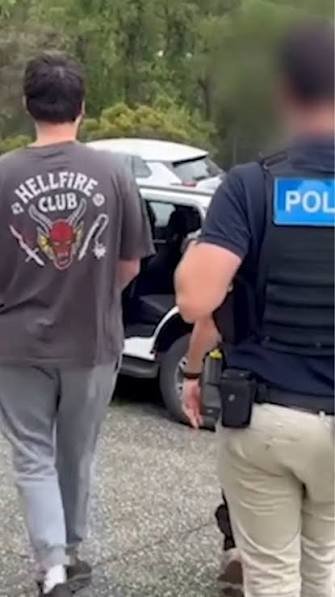
Detectives from the Queensland Police Service Counter-Terrorism Investigation Group arrested the young man yesterday. They will allege in court that he had been making plans to carry out acts of violence.
Police opposed his release on bail. He was listed to appear before Gladstone Magistrates Court today.
Officers have been careful to calm public fears. They say there are no “ongoing direct threats” to the wider community.
But they have also issued a direct appeal, urging anyone with information about this case, or about any other potential threat, to come forward to Queensland Police.
Few further details have been released. Police have not publicly disclosed any alleged target, motive or ideology, and the allegations have not been tested in court.
The man has not yet entered a plea and is entitled to the presumption of innocence.
Yet even the bare facts tell a confronting story: a man barely out of his teens, living in regional Queensland, now at the centre of a terrorism prosecution.
The case does not exist in isolation. It arrives against a backdrop of mounting warnings from Australia’s most senior security officials that the face of terrorism in this country has changed dramatically.
In August 2024, the Australian Security Intelligence Organisation raised the national terrorism threat level from “possible” to “probable”.
At the time, ASIO said more Australians were being radicalised, and radicalised more quickly, with a growing number embracing a diverse mix of grievances and ideologies.
Central to that warning was the role of young people.
Security agencies have repeatedly flagged that a significant share of their counter-terrorism caseload now involves teenagers, many of whom are drawn in through online forums, encrypted chat groups and violent content circulated on social media.
Over recent years, Australians have watched a string of cases involving young people charged with terrorism-related offences across several states, prompting fresh debate about online radicalisation and the adequacy of early intervention programs.
The internet has flattened geography. A teenager in a regional town now has the same access to extremist material as someone in a capital city, and often far less scrutiny.
Analysis: What This Means for Australia
The Gladstone arrest sends a blunt message: violent extremism is no longer a problem confined to Sydney or Melbourne.
From a national security perspective, the case underscores how the threat has become decentralised. Large, organised cells have given way, in many instances, to individuals operating alone, whose intentions can be harder to detect.
That makes community vigilance more important than ever.
Indeed, the most striking feature of this case is how it came to light. It was not, according to police, the product of a sweeping surveillance operation.
It was a tip from an ordinary Australian. That will be seen by authorities as proof that the National Security Hotline, often overlooked by the public, remains a vital line of defence.
For law enforcement, the case highlights the challenge of intervening early enough to prevent harm, while still building charges that can withstand courtroom scrutiny. The planning offence at the heart of this case exists precisely so police can act before violence occurs, rather than after.
The community impact is also significant. Gladstone is a tight-knit city of roughly 30,000 people, with a large workforce tied to critical energy and export infrastructure.
News of a terrorism charge in such a place inevitably unsettles families, schools and workplaces, even when police stress there is no ongoing threat.
There are broader social consequences too.
Each new case involving a young person intensifies pressure on governments to address youth crime, mental health support, social isolation and the influence of tech platforms on vulnerable minds.
Parents are left asking an unsettling question: how well do we really know what our children are consuming online?
Security analysts say the case fits a pattern that has worried intelligence agencies for several years: young men, often isolated, moving from online exposure to violent intent at alarming speed.
Law enforcement insiders warn that regional areas can present particular difficulties. Fewer specialist resources on the ground can mean warning signs go unnoticed for longer, making tip-offs from the public all the more critical.
Counter-extremism observers believe the outcome of this case reinforces the value of a “whole of community” approach, in which friends, relatives, teachers and colleagues feel empowered to report concerning behaviour without fear of overreacting.
Others point out that early reporting does not only protect potential victims. In some instances, it can also redirect a young person away from a path that would otherwise end in tragedy or a lengthy prison term.
Civil liberties advocates, meanwhile, typically urge caution, noting that terrorism charges carry enormous stigma and that the allegations must be proven before a court. Their reminder is a fair one: at this stage, nothing has been established beyond the police case.
What is clear is that a single call from a concerned citizen set this entire chain of events in motion. Authorities will hope that example encourages others to speak up.
Anyone with information about this matter or any other possible threat is urged to contact Queensland Police or the National Security Hotline. In an emergency, call Triple Zero (000).
Further coverage on terrorism and national security is available as the case progresses.