
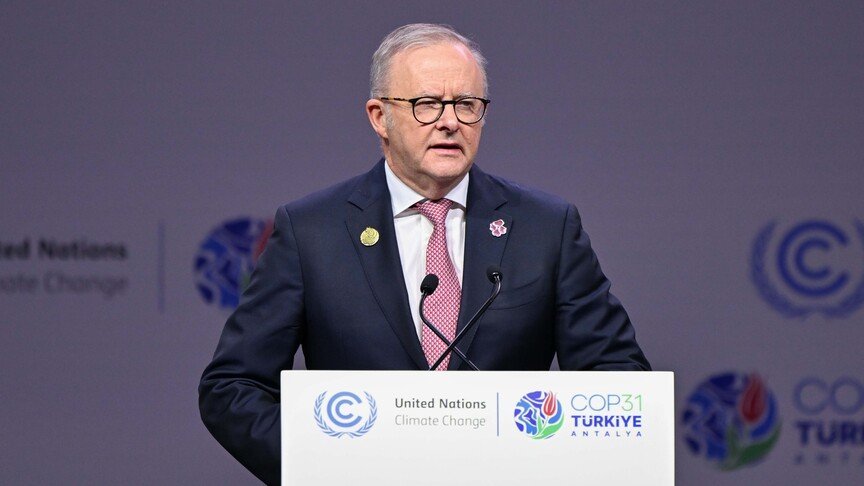
‘A Burning Planet’: Albanese’s Pacific Gamble at COP31 Exposes Australia’s Fossil Fuel Contradiction as Coalition Seizes on $32,000 Coffee Cart
- Anthony Albanese rallied the world behind Tuvalu and other drowning Pacific nations, but his speech landed to a muted room straight after a scathing attack on fossil fuel producers by the outgoing UN chief.
- Pacific leaders publicly backed Canberra, handing Labor a valuable diplomatic win in a region where Beijing is also competing for influence.
- Climate Minister Chris Bowen, who is presiding over the negotiations, is defending a slow, staged exit from coal and gas while Brazil and more than a dozen nations push ahead with their own fossil fuel phase-out plans.
- Back home, Opposition Leader Angus Taylor is targeting a $32,000 free coffee station at Australia’s pavilion, a scheme first introduced while he was energy minister.
For the people of Tuvalu, the threat is not decades away. It is lapping at their doorsteps.
That was the message Anthony Albanese carried to the Turkish coastal city of Antalya this week, as world leaders gathered for COP31. But beneath the warm handshakes and carefully staged photographs, the summit has laid bare an uncomfortable truth about Australia’s climate ambitions.
Canberra wants to be seen as a champion of the Pacific. It also remains one of the world’s biggest exporters of coal and gas.
And in the halls of the UN conference, those two realities are increasingly difficult to reconcile.
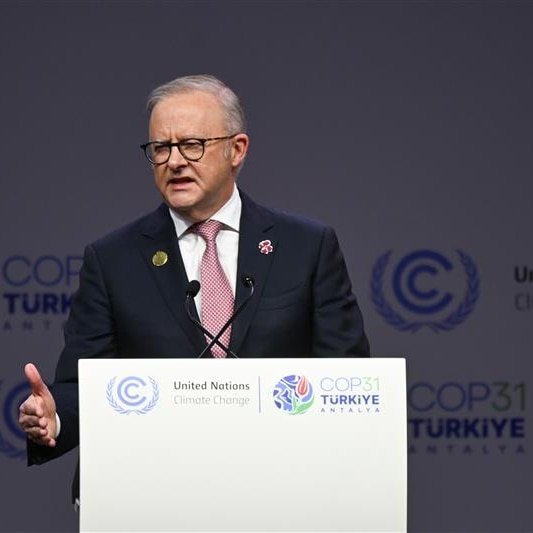
The Prime Minister used his opening address at the leaders’ summit to issue a call to arms on behalf of small island states facing an existential crisis from rising seas.
The response was lukewarm. Delegates seated towards the rear of the plenary hall offered polite applause, but little more.
Observers noted that the speech dwelt more on household batteries than on the dangers of continued coal and gas extraction.
Timing did Albanese no favours.
He took the stage after António Guterres, who used his last COP appearance as UN secretary-general to tear into nations that keep approving fossil fuel projects while failing to tax them properly.
Guterres warned that peace could not be built on a planet that was on fire.
He did not single out Australia or host nation Türkiye.
But activists have long targeted both countries over their deep ties to the resources sector, and the subtext was not lost on many in the room.
Chris Bowen, the Climate Change and Energy Minister serving as president of negotiations at this year’s talks, told the ABC that Guterres was restating a position he had held for years and was not aiming at any particular nation.
The pressure on Australia has been building for some time.
Labor’s bid to host COP31 in Adelaide fell short, with Türkiye winning hosting rights instead, but Australia secured the role of steering negotiations, putting Bowen at the centre of the diplomatic action.
Albanese and Bowen have repeatedly rejected claims of hypocrisy. Their argument is consistent: Australia is pulling its weight, but any transition must deliver energy that is reliable and affordable, not just clean.
That stance has been tested by events far beyond the conference hall.
Bowen said the war in the Middle East and the oil shock that followed had strengthened the argument for electrification and renewables, even among nations where climate action has not been a top priority.
Rising fuel prices have made energy security a pressing concern worldwide.
Former California governor Gavin Newsom, speaking at a sideline event, described overhauling how nations produce and consume energy as a strategic imperative. He warned China was racing ahead of the United States on clean energy, despite remaining a major emitter, saying Beijing was “cleaning our clocks”.
Yet a global road map to transition away from fossil fuels remains elusive.
After last year’s summit failed to reach consensus, Brazil announced it would forge ahead alone, joining more than a dozen countries that have released voluntary plans.
Bowen has avoided pre-empting next week’s talks, instead defending a gradual transition and arguing that electrification still counts as progress even when not fully powered by renewables.
Analysis: What This Means for Australia
Make no mistake: climate diplomacy is now national security policy.
The Pacific is one of the most strategically contested regions on Earth, and every gesture of solidarity from Canberra is a counterweight to growing Chinese influence among island nations.
On that front, Labor appears to be winning. Albanese shared the stage with Pacific leaders throughout the summit, and they returned the favour.
Palau’s President Surangel Whipps Jr said small island nations often struggled to be heard on their own, describing climate change as a direct threat to Pacific food supplies, economies and sovereignty.
That endorsement matters.
A Pacific that sees Australia as a reliable partner is less likely to look elsewhere for security agreements, infrastructure finance and policing support, issues tracked closely by the Department of Foreign Affairs and Trade.
But the fossil fuel contradiction is a vulnerability. Coal and gas exports underpin billions of dollars in national revenue and thousands of jobs in regional communities.
Any sharp pivot would hit those towns hard. Yet continued expansion risks eroding the trust Australia has worked so hard to build with neighbours facing rising seas.
For households, the stakes are just as tangible. The oil crisis has exposed how vulnerable Australians are to global supply shocks, feeding directly into the cost of living crisis and electricity bills.
That is precisely the terrain the Coalition is fighting on. Opposition Leader Angus Taylor has attacked the $32,000 spent on a coffee station at Australia’s pavilion, where long queues form daily for free lattes.
Bowen has hit back, pointing out the free coffee scheme began when Taylor himself held the energy portfolio. Taylor counters that tougher economic conditions mean spending once considered acceptable, including a prime minister flying to COP, no longer passes the test.
The sum is a rounding error in Australia’s diplomatic budget. But politically, it resonates with voters already squeezed by inflation.
Among Australians in Antalya, a common joke is that Labor MPs should be relieved Adelaide lost the hosting bid. The coffee bill would have been trivial next to the cost of policing, security, gridlocked traffic and the logistical chaos of hosting world leaders.
Foreign policy analysts say Australia’s Pacific-first strategy is delivering real strategic dividends, warning that walking away from the region on climate would open the door to rival powers.
Climate policy observers believe the government’s focus on implementation is defensible, given many nations are already falling short of existing targets. Raising ambitions without credible pathways, they argue, achieves little.
But others warn that implementation cannot become an excuse for dodging stronger commitments.
Energy sector insiders suggest the Middle East oil shock may ultimately do more to accelerate the transition than any summit communiqué, as governments prioritise insulating their economies from volatile fuel markets.
Political strategists say Labor is caught in a vice, unable to satisfy climate advocates demanding a fossil fuel exit or an opposition hammering every dollar spent abroad.
The real test, they warn, is whether the government’s pragmatic middle path can produce enough tangible results to justify the leadership role it is so eager to claim.