
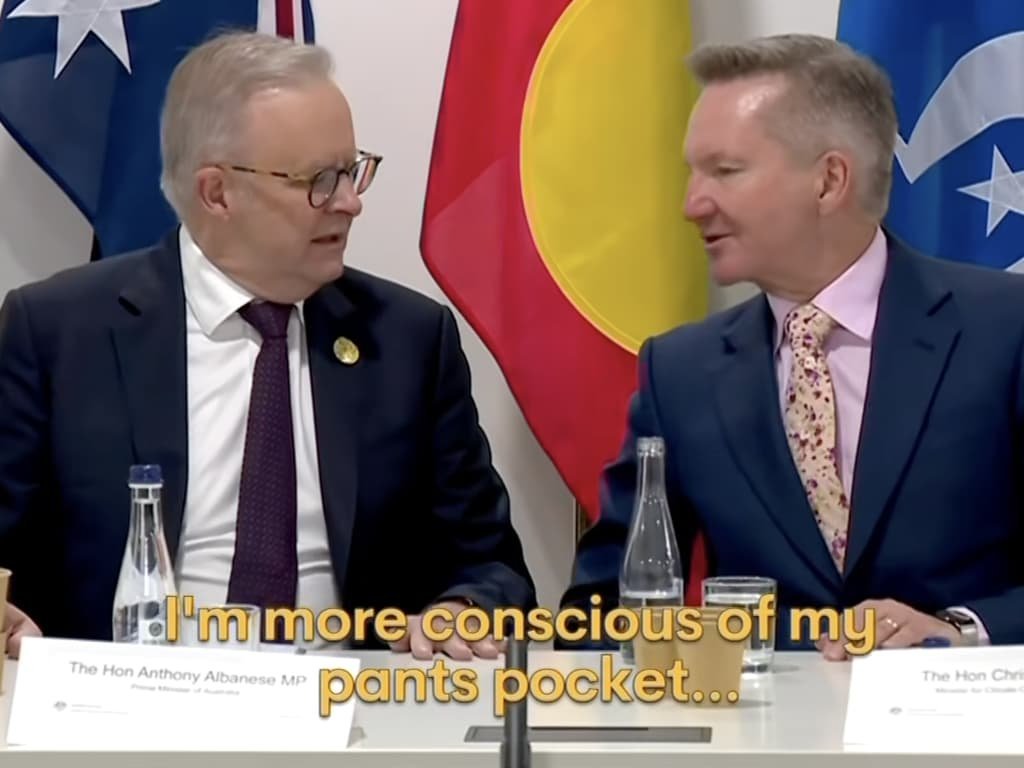
‘Because of Your D**k?’: Albanese and Bowen Caught in Cringeworthy Hot Mic Blunder at COP31 as PM Heads Into High-Stakes Showdown With Trump
- Anthony Albanese and Climate Minister Chris Bowen were recorded joking about where men should keep their mobile phones, unaware their microphones were live
- The PM warned Bowen to keep his phone “away from your heart” before making a crude quip about his minister’s trouser pocket
- The awkward exchange happened in the final hours of a climate summit where Australia had fought hard for a leading role
- Albanese is now travelling to the Philippines and China, where he may come face-to-face with Donald Trump as the US President grapples with the Iran war and a midterm defeat
It was supposed to be the triumphant closing act of Australia’s biggest climate diplomacy push in a generation.
Instead, the lasting image from Turkey may be the Prime Minister of Australia making a crude joke about his Climate Minister’s genitals, captured on a microphone neither man realised was still recording.
In a moment that will delight his critics and horrify his media advisers, Anthony Albanese was overheard trading banter with Chris Bowen during a pause in proceedings as the COP31 climate conference entered its final hours.
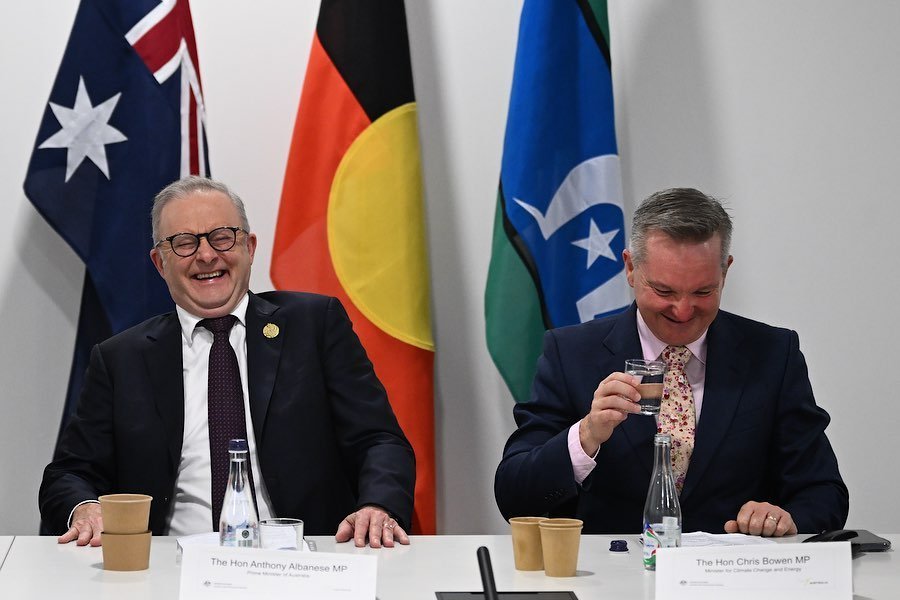
The subject was not emissions targets or climate finance. It was mobile phones, and where a man should carry one.
Gesturing to the breast pocket of his suit jacket, Albanese asked Bowen whether he kept his phone there, then promptly advised him against it, saying the device belonged somewhere away from the heart.
Bowen responded that he was actually more careful about keeping his phone in his trouser pocket.
The Prime Minister’s reply was blunt. “Because of your d**k?” he asked.
Bowen agreed, describing that part of his anatomy as rather important, and arguably more so than his heart.
Both men laughed. Neither appeared to have any idea the exchange was being picked up.
The pair seemed to be riffing on the long-running public debate over whether radiofrequency energy from mobile phones poses risks to the body when devices are kept close for long periods.
A spokesperson for the Prime Minister moved quickly to downplay the episode, insisting it was nothing more than a light-hearted joke between meetings.
By then, Albanese had already left Turkey. He is now bound for the Philippines and will then travel on to China as part of an extended overseas tour.
The timing could hardly be more awkward. COP31 was never meant to be just another summit for Australia.
Canberra had campaigned for years to bring the conference to Australian soil, pitching Adelaide as host city and promising to put Pacific nations at the centre of global climate talks.
That bid collided with a rival push from Turkey, and the deadlock was eventually broken with a compromise that saw Turkey host the event while Australia took a leading role in steering the negotiations.
For Bowen, that made this summit the defining test of his ministerial career. For Albanese, it was a chance to show the world that Australia had shed its old reputation as a climate laggard.
Against that backdrop, being remembered for a joke about where Bowen keeps his phone is not the legacy either man would have chosen.
The science behind the banter is also worth noting.
The Australian Radiation Protection and Nuclear Safety Agency has long stated there is no established evidence that the low-level radiofrequency exposure from mobile phones causes adverse health effects, though the topic remains a persistent source of public anxiety and health misinformation.
Analysis: What This Means for Australia
On its face, this is a harmless gaffe.
But the real story is the diplomatic gauntlet Albanese is now running, and the reminder that every word a leader utters on the world stage can be captured and broadcast.
The Prime Minister is heading into a region where Australia’s national security interests are most acutely at stake.
The summits in the Philippines and China bring together the major powers that shape Australia’s strategic environment, from trade routes through the South China Sea to the delicate balance between Washington and Beijing.
Donald Trump is also expected to attend both gatherings.
It will be his first appearance at a global summit since the Republican Party suffered a defeat in the midterm elections, leaving the President weakened at home and potentially more unpredictable abroad.
Trump is expected to use the meetings to push his agenda on the Iran war and on trade, two issues with direct consequences for Australians.
Conflict in the Middle East feeds straight into global oil markets and fuel prices, while any shift in American trade policy threatens exporters already rattled by Trump tariffs.
Albanese is expected to have an opportunity for a face-to-face conversation with Trump. Those encounters are scarce and precious for any Australian leader, and the stakes for the AUKUS partnership, defence co-operation and market access are enormous.
Then there is China, Australia’s largest trading partner.
A visit there lands squarely in the middle of a long, painstaking effort to stabilise relations after years of trade sanctions that hammered farmers, winemakers and miners.
In that context, a slip of the tongue matters less for its crudeness than for what it reveals about discipline.
Hot mics have embarrassed leaders across the globe, and an off-colour remark in the wrong room could carry far greater consequences than a laugh about phone pockets.
Political strategists say the incident is unlikely to cause lasting damage at home, where many voters may see it as a rare glimpse of unscripted humour from a famously cautious Prime Minister.
But Canberra insiders warn that the opposition will seize on any perception that Labor’s climate push was more about spectacle than substance, particularly as households continue to struggle with the cost of living and energy prices.
Diplomatic observers believe the far greater test lies ahead. Navigating a bruised and combative Trump while simultaneously courting Beijing requires precision, and there is little margin for error when both superpowers are watching closely.
Security analysts say Australia’s position in the Indo-Pacific has rarely been more finely balanced.
With war in the Middle East, trade tensions simmering and American politics in flux, the conversations Albanese holds over the coming days could shape the nation’s economic and strategic footing for years.
Former government advisers note that leaders now operate in an environment where every room may be recording, and every aside can circle the globe within minutes.
For now, the Prime Minister’s office is hoping the episode is filed away as a laugh between colleagues.
Whether Albanese’s next unguarded moment comes in front of Donald Trump or Chinese officials, he will no doubt be checking the microphone first.