
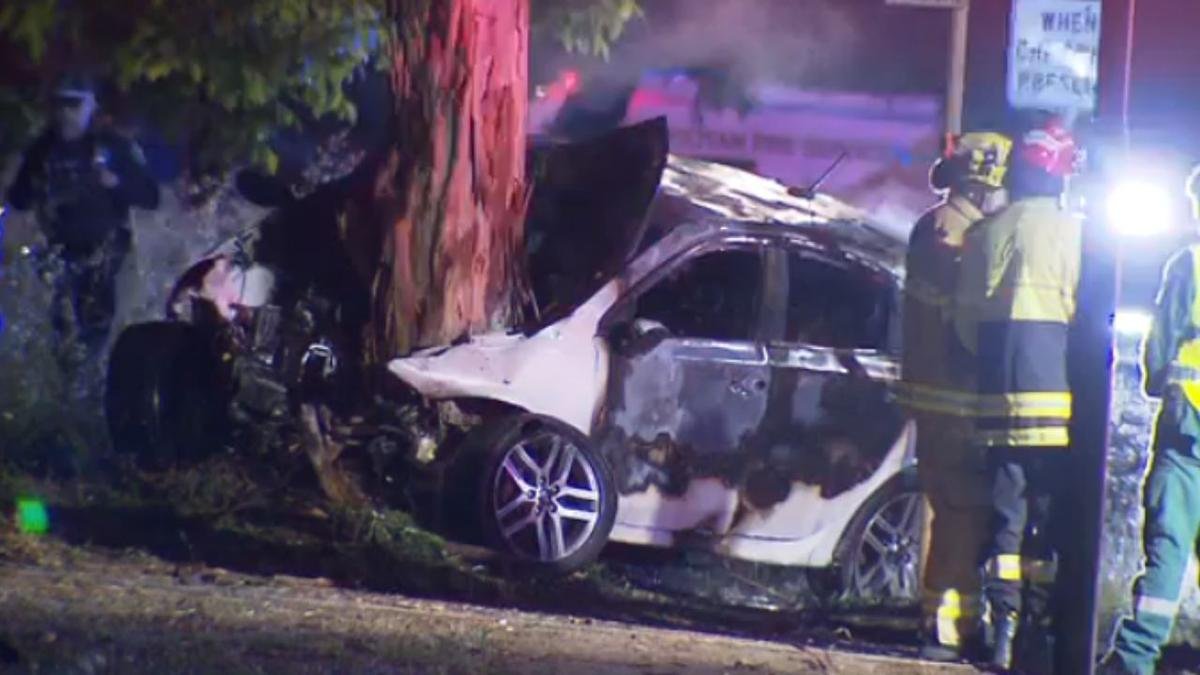
‘The Water Was Turning to Steam’: Horrified Neighbours Battle Inferno With Garden Hoses as Young Woman Dies Trapped in Burning Car After Pre-Dawn Smash Into Gum Tree in Adelaide’s South
- A 29-year-old woman from Port Noarlunga has died after her Kia sedan ploughed head-on into a gum tree and erupted in flames at Flagstaff Hill
- Residents jolted awake by what they described as two thunderous explosions ran into the street with garden hoses, but the heat was so fierce their water turned to steam
- Investigators believe the car hit metal barriers near a pedestrian crossing roughly 200 metres before the tree, and found no skid marks at the scene
- Her death is the 91st on South Australian roads this year, deepening alarm over a road toll that keeps tearing through local communities
It began with a sound that shook houses to their foundations.
Then came a second blast, and a wall of fire lighting up a quiet suburban street in the dead of night.
By the time the flames were out, a young woman was dead, a community was traumatised, and South Australia had recorded yet another life lost in a year already scarred by grief on its roads.
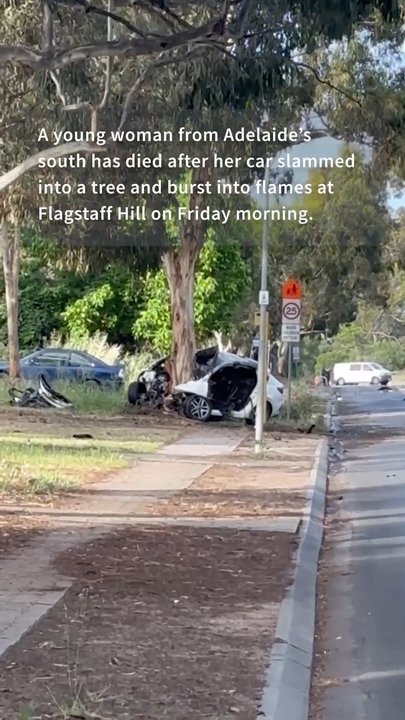
The 29-year-old, from the coastal suburb of Port Noarlunga, was killed when the Kia sedan she was driving slammed head-on into a towering gum tree on Manning Road at Flagstaff Hill, in Adelaide’s southern suburbs, shortly before 4am on Friday.
The car burst into flames on impact, trapping her inside.
Emergency crews raced to the scene after a flood of calls from terrified residents. But neighbours were there first, and what they witnessed will stay with them forever.
One local, Ryan Beare, said the collision was so violent it rattled his home, and he instantly sensed something terrible had unfolded outside.
Another resident, Stewart Purdie, described hearing two separate detonations in quick succession: the first the sickening crunch of metal on timber, the second the roar of the vehicle exploding into fire.
Without hesitation, neighbours grabbed garden hoses and ran towards the blaze.
Mr Beare recalled standing just a few metres from the burning Kia, desperately aiming water at the flames.
The car was completely engulfed, he said, and the heat was so savage that the spray was vaporising into steam before it could do any good.
Despite their courage, and the frantic efforts of emergency crews who arrived soon after, the woman could not be saved. She died at the scene.
Firefighters from the Metropolitan Fire Service brought the inferno under control, before the grim task of piecing together her final moments fell to the Major Crash Investigation Unit of South Australia Police.
Early findings paint a troubling picture.
Investigators believe the sedan first collided with metal barriers positioned near a pedestrian crossing, roughly 200 metres before it reached the tree. Crucially, there were no skid marks found anywhere around the scene.
What that means remains unclear. Police have not indicated what caused the car to leave its path, and the investigation is ongoing.
Officers spent hours combing the wreckage and the surrounding roadway through the morning. Manning Road was shut between Emerald Street and Topaz Drive as crews worked, causing disruption for commuters in the area.
It has since reopened.
Police are now appealing for anyone who saw the crash, or who has dashcam footage captured in the area around that time, to come forward.
The tragedy lands at a moment when South Australians are growing increasingly weary of headlines like this one.
This woman’s death is the 91st fatality recorded on the state’s roads so far this year.
Every one of those numbers represents a family left shattered, a workplace with an empty desk, a circle of friends forced to confront an unthinkable loss.
The road toll has become a recurring flashpoint in South Australia, with each fresh death renewing scrutiny of driver behaviour, road design and the conditions motorists face on suburban arterials in the small hours.
Pre-dawn crashes carry their own particular menace.
Roads are emptier, help is slower to arrive, and the chances of a single-vehicle collision going unwitnessed until it is too late are far higher.
Analysis: What This Means for Australia
Fiery single-vehicle crashes like the one at Flagstaff Hill expose an uncomfortable truth about road safety across the country: the deadliest dangers are often found not on remote highways, but on familiar suburban streets.
For law enforcement, the absence of skid marks presents a complex puzzle. Investigators must now consider every possibility, from mechanical failure to a medical episode, without leaping to conclusions.
That painstaking work is precisely why public appeals for dashcam footage have become such a vital tool for police nationwide.
For communities, the toll is deeply personal. Residents in Flagstaff Hill did not merely hear about a tragedy.
They lived it, standing helplessly in the heat as they fought to save a stranger. The psychological impact on witnesses and first responders is frequently overlooked once the road reopens and the cameras leave.
There are wider consequences too. Every fatal crash places enormous strain on emergency services, the health system and the families left to navigate grief alongside practical and financial hardship.
Road trauma remains one of the most significant preventable drains on Australian society, in both human and economic terms.
And the role of roadside infrastructure, including barriers and the placement of large trees alongside busy roads, is likely to face fresh questions as investigators establish exactly how this crash unfolded.
Road safety advocates say incidents like this underline how quickly an ordinary drive can turn catastrophic, and how little margin for error exists when a vehicle strikes a solid object at speed.
Law enforcement insiders warn that the lack of braking evidence at a crash site is always treated seriously, and that witness accounts and footage can be decisive in filling the gaps.
Emergency response observers believe the actions of the neighbours, while ultimately unable to change the outcome, reflect an extraordinary instinct to help, but caution that vehicle fires can escalate with terrifying speed and pose real danger to would-be rescuers.
Community figures say the emotional aftermath for those who witnessed the scene should not be underestimated, urging residents affected by the crash to seek support.
For now, a family in Adelaide’s south is mourning a 29-year-old whose life was cut short in the darkness before dawn.
And on Manning Road, a scorched gum tree stands as a stark reminder of how fragile that life, and every life on our roads, truly is.
Anyone with information or dashcam footage is urged to contact Crime Stoppers or South Australia Police.